Showing posts with label Baltimore Orioles. Show all posts

Tuesday, March 15, 2022

Baseball's Most Exciting Games, No. 26: The Perfect Bunt

Game 1, 1969 ALCS: Minnesota Twins at Baltimore Orioles

October 4, 1969, Memorial Stadium, Baltimore, Maryland

After operating with the same 16 teams for 60 years, the American and National Leagues each added two teams in 1961/1962, and then again in 1969. That second expansion in 1969 brought both leagues to 12 teams and inspired another major change: the introduction of divisions. 

Though divisions were new in 1969, they didn't really add any drama to the pennant races. The Orioles, winners of 109 games, would have won the league by 12 games had the league not been split up. As it was, they won the brand new East Division by 19 games. Their reward for winning the division so comfortably was a showdown with the Twins, who won the West by 9 games.

With seven future hall of famers on the field (including two who got elected this year, Jim Kaat and Tony Oliva of the Twins), there was the hope that despite the Orioles' gaudy record, the Twins could put up a good fight in the series. Luckily, the first ever ALCS game lived up to the hype and beyond, easily justifying its new existence.

The Orioles used two solo home runs off Twins ace Jim Perry to take 2-1 into the top of the seventh. After Mike Cuellar struck out Rod Carew, Harmon Killebrew drew a walk. Cuellar then hung a curveball that Oliva happily hit over the fence to give the Twins a 3-2 lead.

The score stayed that way until the bottom of the ninth when Boog Powell hit a leadoff home run off Perry. After another hit, the Twins brought in star reliever Ron Perranoski to try to shut down the rally. (Why didn't they bring him in to start the inning, you ask? That's a wonderful question, and I'm glad you asked it). 

Another batter reached base on an error, and the Orioles ended up with runners on first and third with two outs. That's when Orioles manager Earl Weaver got cute, trying to surprise Perranoski with a double steal. Perranoski wasn't fooled and threw to home in time to easily catch Brooks Robinson trying to steal home.

Extra innings were quiet until the top of the 12th, when the Twins loaded bases with 1 out in 12th. Weaver brought in reliever Dick Hall, who got two straight outs to end the threat. (Apparently Weaver actually knew how to use relievers).
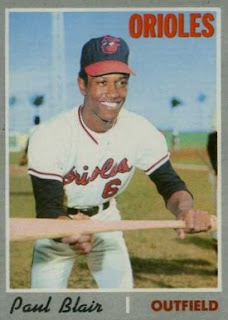
Paul Blair's 1970 baseball card, in
which he demonstrated exactly how
he beat the Twins in Game 1.
The bottom of the 12th was Perranoski's 4th inning of relief. (Why didn't the Twins bring in anybody else, especially since they could have pinch-hit for Perranoski in the top of the 11th? That's a wonderful question, and I'm glad you asked it). Perranoski gave up a leadoff single to Mark Belanger. Two ground outs followed - one of which was a sacrifice - to get Belanger to third with two outs and Paul Blair at the plate. 

With one strike, Blair took a big swing and missed, putting the Twins one strike from surviving the rally. Then Blair pulled off one of the gutsiest plays imaginable, dropping a beautiful two-strike, two-out bunt about 20 feet beyond the plate towards third base, placed perfectly between Perranoski and catcher John Roseboro so neither could pick it up in time to either throw out Blair or tag out Belanger coming from third. 

Even Twins manager Billy Martin was impressed by Blair's play. Martin - who was so competitive he was fired from the Twins after the season for punching one of his own pitchers - told reporters after the game that "There's no way to beat a perfect bunt," a statement that if made today would cause most people working in baseball front offices to scream in horror. 

Anyway, after winning Game 1 4-3, the Orioles won Game 2 1-0, also in extra innings, before annihilating the Twins in Game 3 to head to the World Series. They lost that series to the Miracle Mets, but they had firmly established themselves as the class of the American League.

Game 1, 1969 ALCS
Overall Rank: 26
Top 10 Swing: 231
Top Play: Boog Powell's tying home run (WPA of 44% for Baltimore)
Loser's largest WE: 89
T9, Twins up 3-2, no outs, runner on second, Rod Carew batting.
Average LI: 1.69
Highest Leverage Moment: 6.83 (T12, 2 outs, bases loaded, tied 3-3, John Roseboro batting)

For more information on Weaver's managerial philosophy, see this video. Be warned, though, that it is definitely rated R.

Friday, September 28, 2012

September 28, 2011: The Final Day

ST. PETERSBURG, Fla. - Where was the best seat in the house for something like this? The final day of the season, four games, four different cities, each with playoff implications. The best place, of course, was your couch at home, where you could take in all the action as it happened - no relying on the scoreboard to show highlights, no peering at the out-of-town scores and wondering if they're up-to-the-minute.

But imagine what it was like in the normally stale Tropicana Field on September 28, 2011, as Rays fans were treated to updates to three games that swung the postseason fortunes of four teams, plus a game happening right in front of them, the first one to start and the last one to end, the one that decided it all.

At 7:10 eastern, the first pitch was thrown in St. Petersburg (Rays vs. Yankees), Atlanta (Braves against Phillies), and Baltimore (Orioles vs. Red Sox). Four hours later, none of those games were over, the two playoff spots available still up for grabs. Their drama easily overshadowed the fourth big game of the night, the Houston-St. Louis tilt that started at 8:10 and was over about 10 minutes later. The Cardinals scored four runs in the first, Chris Carpenter only gave up two hits, and St. Louis beat the hapless Astros 8-0 to clinch a tie for the NL Wild Card spot. After the game, they boarded a plane for St. Louis not knowing if their next game would a one-game playoff at home against Atlanta or Game 1 of the NLDS in Philadelphia.

The Phillies and Braves were deciding that one for themselves down in Dixie, with Atlanta hoping to avert a huge collapse, while Philadelphia was trying to knock their division rival out of the playoffs. Meanwhile, the Rays and Red Sox were tied for the AL Wild Card lead, with the Rays needing to get past the division-champion Yankees at home and the Red Sox forced to deal with the lowly Orioles on the road. The next five hours were a flurry of game- and season-changing swings, shifts of momentum so dramatic it gave viewers whiplash. If you were watching at home and you took too long watching a replay of another dramatic hit, you risked missing watching the next one. It was a baseball night for the ages.

(All Times Eastern)

7:40 - Dustin Pedroia singles for Boston, driving in the first run in Baltimore.
7:54 - Mark Teixiera hits a grand slam for New York, putting the Yankees up 5-0 in the second inning.
8:03 - Dan Uggla homers for Atlanta, putting the Braves up 3-1 in the third.
8:06 - J.J. Hardy hits a two-run home run for Baltimore, putting the Orioles ahead of Boston 2-1.
8:20 - A balk ties the game in Baltimore.
8:35 - Teixiera homers again for New York, making it 6-0. While he's being congratulated in the dugout, Pedroia homers for Boston, and the Red Sox are ahead 3-2.
9:07 - After three scoreless innings in Atlanta, the Braves' Jack Wilson commits an error to reduce the Braves' lead to 3-2.
9:34 - With Boston leading 3-2, the seventh-inning stretch turned into a rain delay. As they walked into their clubhouse, they saw that Tampa Bay was trailing 7-0, and they breathed a sigh of relief. They had gone 7-19 in September to blow a 9-game lead in the wild card, but now it looked like they'd get in anyway. After all, at that exact point, Tampa Bay's win expectancy was 0. Nada. The Red Sox sat back to watch like the rest of the country.

While it was raining in Baltimore ...

9:56 - A Chase Utley sacrifice fly ties the Philadelphia-Atlanta game at 3-3 in the top of the ninth.
10:11 - Wilson strikes out for the final out in the bottom of the ninth. Atlanta and Philadelphia are going to extra innings.
10:17 - Sam Fuld draws a bases-loaded walk for Tampa Bay's first run. It was still 7-1 in the eighth inning in their game, but Fuld's walk was the start of something. Because then Sean Rodriguez was hit by a pitch to score a second run, and a sacrifice fly scored a third run. Then, at
10:23 - Evan Longoria hits a three-run home run to cut the Rays deficit to 7-6.

Here, then, came one of those Baseball Moments, the kind of thing that happens only in America's oldest sport. At 10:47, the Rays were one out from likely elimination. They were trailing 7-6, while the Red Sox were waiting out a rain shower with a 3-2 lead. Coming up to bat for Tampa Bay was Dan Johnson, a .108 hitter who hadn't gotten a hit since April 27. The last hope for Tampa had almost no hope of getting it done. But then,

10:47 - Johnson hits a deep line drive to right field that says fair by about two inches. Home run. Tie game. Bedlam. Chaos. And the night was just getting started.
10:58 - In Baltimore, the Red Sox wander out of the clubhouse in a daze. Their game was continuing, while they had watched their sure playoff berth disappear into the seats in Tampa Bay. They still had the lead in their game, but if this was a boxing match, they were staggering.
11:13 - In Atlanta - remember this game? - Martin Prado grounds out with runners on the corners to end the 12th inning. On to the 13th.
11:18 - Boston's Marco Scutaro is thrown out at home trying to extend Boston's lead. It remains 3-2 entering the ninth.
11:28 - A two-out infield single by Hunter Pence in the 13th inning gives the Phillies the lead for the first time since the top of the first.
11:40 - Phillies 4, Atlanta 3, Final. Atlanta is eliminated. On their flight back home, St. Louis starts to celebrate their playoff berth. Meanwhile, Jonathan Papelbon is in the game to close it out for Boston, with a win giving them no worse than a tie for the Wild Card. He strikes out the first two batters before giving up a first-pitch double to Chris Davis.
11:59 - Nolan Reimold hits a double for Baltimore, tying the game.
12:02 - Robert Andino hits a sinking liner to left. At first, it looks like Carl Crawford is going to catch it, but he just misses it. Reimold scores. Baltimore wins. The Red Sox walk off the field in shock, their collapse complete.


12:05 - In St. Petersburg, with Evan Longoria up in the bottom of the 12th, the sign appears on the scoreboard: BAL 4, BOS 3, F. The crowd goes wild, cheering madly and ringing their cowbells, believing in miracles. The Rays are on the top step of the dugout, pounding the railing in anticipation. Longoria steps out of the batters box because of the cheering, calming himself. He steps back in. He swings. A low liner to left. Hooking. Sinking.

Gone.

Tuesday, September 18, 2012

1971 World Series: Clemente and Blass

The Teams
National League: Pittsburgh Pirates (97-65) - Sixth World Series (Won in 1909, 1925, 1960)
American League: Baltimore Orioles (101-57) - Fourth World Series (Won in 1966, 1970)

What Happened
Roberto Clemente was 37 years old in 1971, at the tail end of a brilliant career. He could always hit - boy, could he hit, including a .341 average in 1971 - and he could throw. Boy, could he throw. Longtime announcer Vin Scully once said Clemente could field a ball in New York and throw out a runner in Pennsylvania. He was exaggerating, but not by much. Yet for all his brilliance, his consistency, he was often overshadowed by the brighter stars of his day, namely Hank Aaron and Willie Mays, partially because he didn't hit home runs like they did, but mostly because of latent - or blatant discrimination against Latin players.

The 1971 World Series, then, was probably his last chance to shine. He had played in the 1960 World Series that Pittsburgh had won, of course, getting a hit in all seven games, but he hadn't yet established himself as a star. Even if he had, anything positive he accomplished that series was virtually ignored by the flat-out bizarre way the Pirates won that series. Clemente hadn't gotten his proper due. Now was his time.

Steve Blass was 29 years old in 1971. He had shown some flashes of brilliance during his previous six years with Pittsburgh, but for the most part had been an average to above-average pitcher through his first six years. But down the stretch in 1971, Blass caught fire. He threw three straight complete games, winning them all, as Pittsburgh held off St. Louis to win the NL Central. He was so good down the stretch that the Pirates picked him to start Game 1 of the NLCS against San Francisco.

The Orioles won the first two games of the World Series that year, to no one's surprise. The two wins gave them a stunning 16 straight wins. The Orioles were very good; they had great pitching, (the first team to have four 20-game winners on one staff), they played great defense (led by the great Brooks Robinson), and had a powerful, brutal lineup. They were an outstanding team ... and they were dead in the water. They just didn't know yet what fate had in store for them.

As it was, though, Clemente told his teammates before Game 3 that he had them the rest of the way, that he was gonna win this series. Blass heard the message and decided to give Clemente some help, throwing a complete-game three-hitter to shut down Baltimore. Clemente, meanwhile, drove in Pittsburgh's first run, then started the seventh-inning rally that was capped by a Bob Robertson three-run home run. Pittsburgh won 5-1, and the series was on.

They won the next two games, with Clemente getting four hits while Blass waited his turn for a potential Game 7 start. After Baltimore won Game 6 - despite a Clemente home run - Blass got the ball. In Game 7, Clemente homered in the fourth to open the scoring - a hit that gave him a hit in all 14 World Series games he ever played in - and Blass took it from there. An insurance run in the top of the eighth proved vital when Baltimore finally got to Blass for a run in the bottom of the 8th. He got out of that jam, then breezed through the ninth, and the Pirates were the champions.

They celebrated long and hard. Clemente finally received recognition as a true superstar, while Blass was hailed as baseball's next big pitching star. While Clemente was nearing the end, they were both hailed as the cornerstones of a potential Pittsburgh dynasty. And they made it back to the postseason in 1972, only to be cut down by the Big Red Machine. And then ...

And then Blass couldn't through strikes. A good control pitcher throughout his career, Blass suddenly lost it all. Throughout 1973, he couldn't throw strikes at all. He struggled through 18 starts, ending up with almost as many walks as innings pitched. He spent 1974 in the minors, and it got worse. Eventually, completely unable to throw strikes, Blass had to retire. He left a legacy on the game, however: now anytime a pitcher unexpectedly and irreversibly loses the strike zone, he is said to suffer from Steve Blass Disease.

Blass' fate, though, was nothing compared to Clemente's. His story is often repeated; he got his 3,000th career hit in his final at bat of the 1972 season, the hit that helped make the 3,000-hit milestone an important one for hitters. That offseason, he organized relief efforts for earthquake victims in Nicaragua. Worried the supplies wouldn't get to where they were supposed to go, Clemente hopped on the plane to escort the supplies to Nicaragua. He never made it, going down with the plane into the Caribbean Sea. In death, his legend grew even more, and he became the shining star of Latin American baseball.

In different ways, Blass and Clemente might have been cursed, living on borrowed time. Clemente certainly spoke like he didn't expect to be on earth for very long. Maybe the 1971 series ended the way it did for a specific reason. Maybe the Pirates of Blass and Clemente were fated to win, to beat the mighty Orioles, to remind all athletes the randomness of success, how fickle the baseball gods could be.

MVP
Clemente batted .414, had five extra-base hits, played sensational defense - including one of the best throws anybody had ever seen - and single-handedly carried the Pirates to the championship. He was the first Latin player to win the award, and in doing so did something that even Aaron and Mays never did.

Scores
(Home team shaded; winners in Bold)


Pittsburgh 3354 422
Baltimore5111 303 (10)1

The List
I'm ranking all the World Series, from worst to best. Here are the ones I've done so far:

25. 1971 - Pittsburgh (N) def. Baltimore (A) 4-3
26. 1918 - Boston (A) def. Chicago (N) 4-2
27. 1988 - Los Angeles (N) def. Oakland (A) 4-1
28. 1946 - St. Louis (N) def. Boston (A) 4-3
29. 1925 - Pittsburgh (N) def. Washington (A) 4-3
Numbers 30-39
Numbers 40-49
Numbers 50-59
Numbers 60-69
Numbers 70-79
Numbers 80-89
Numbers 90-99
Numbers 100-107


Game 7s
Simultaneously, I'll rank all the Game 7s. The ones that have appeared in my countdown so far:

7. 1946: St. Louis (N) 4, Boston (A) 3
9. 1925: Pittsburgh 9, Washington 7
12. 1979: Pittsburgh 4, Baltimore 1
13. 1955: Brooklyn 2, New York (A) 0
15. 1971: Pittsburgh 2, Baltimore 1
16. 1940: Cincinnati 2, Detroit 1
18. 1987: Minnesota 4, St. Louis 2
19. 1958: New York 6, Milwaukee 2
21. 1968: Detroit 4, St. Louis 1
22. 1931: St. Louis (N) 4, Philadelphia (A) 2
26. 1982: St. Louis 6, Milwaukee 3
28. 1965: Los Angeles (A) 2, Minnesota 0
29. 1964: St. Louis 7, New York (A) 5
30. 1957: Milwaukee 5, New York (A) 0
31. 1967: St. Louis 7, Boston 2
32. 1945: Detroit 9, Chicago (N) 3
33. 1909: Pittsburgh 8, Detroit 0
34. 1934: St. Louis (N) 11, Detroit 0 
36. 1985: Kansas City 11, St. Louis 0

Saturday, September 1, 2012

1969 World Series: Simply Amazin'

The Teams
National League: New York Mets (100-62) - First World Series
American League: Baltimore Orioles (109-53) - Second World Series (Won in 1966)

What Happened
The Summer of '69 was the middle of a great sports year for New York sports fans. The Jets had gotten things started, upsetting the Baltimore Colts in the Super Bowl behind a guarantee by Broadway Joe. That fall, the Knicks started a season that ended with an NBA championship coming to Madison Square. But before all of that could happen, New York had to make room for the Miracle Mets.

For the first seven years of their existence, the only miracle the Mets performed seemed to be whenever they somehow won a game. No expansion team ever started so poorly, and the ineptitude of those early Mets became fodder for baseball jokes for a generation. But something clicked in 1969. They had a great, young pitching staff, anchored by 24-year-old future Hall of Famer Tom Seaver. They had an outstanding defense, one that would save countless runs for their young pitchers.

As for the offense, well, manager Gil Hodges did what he could. Making liberal use of the platoon system that former Yankee - and Met - manager Casey Stengel had perfected in the 1950s, Hodges somehow found a way for his team to score enough to stay in the NL East race. In mid-August, it all came together, and the Mets ended the season on a 38-11 run to storm past the Cubs and into the playoffs. After easily beating Atlanta in the NLCS, the former punchlines were suddenly in the World Series.

Though the Mets had won 100 games during the season, they were heavy underdogs against the 109-win Orioles. Don Buford led off the series for the Orioles with a home run off Seaver, and Baltimore cruised to an easy win in Game 1, a game that was supposed to be just the first of four straight Baltimore wins. After all, this team was even better than the one that had swept the Dodgers three years earlier, and these Mets weren't nearly as good as those Dodgers. Right?

Well ... Jerry Koosman took a no-hitter into the seventh inning in Game 2 before finally giving up two hits that tied the game. But the Mets bounced back, getting three straight two-out singles in the top of the ninth to take the lead, then holding their breath as Ron Taylor got Brooks Robinson to ground out with two on to end the game. Not only did the Mets have their win to avoid the sweep, but they had gotten a road win. They could now win the series without having to go back to Baltimore.

With the series possibly in the balance in Game 3, Mets centerfielder Tommie Agee took over, putting together one of the greatest all-around games in World Series history. His first-inning home run was just the start. With the Mets up 3-0 in the fourth and two runners on, Baltimore's Ellie Hendricks blasted one deep into the left-center gap. Agee ran the ball down just before crashing into the wall to save two runs. Then in the seventh, Gary Gentry walked three straight Orioles with two outs. 24-year-old Nolan Ryan came in to face Paul Blair. Blair hit a low line drive to right center field that looked dangerous, but Agee came out of nowhere to make a diving, sprawling catch. Agee had saved five runs with his glove and added another run with his bat, the major player in New York's 5-0 victory.

After Agee's heroics, the Mets were on cloud nine. Their fans believed, and probably most importantly, they believed in themselves. After winning a 10-inning thriller in Game 4, they fell behind 3-0 in Game 5. Donn Clendenon hit a two-run home run in the sixth to make it 3-2, and Al Weis tied it with a home run in the seventh. Then in the eighth, Ron Swoboda's double gave the Mets the lead. Three outs later, left fielder Cleon Jones closed his glove on the final out, and the Mets started celebrating. The fans were on the field before the Mets could even escape to the clubhouse. Liquor stores around Queens sold out of their supply of champagne within 10 minutes of the final pitch. It was all to celebrate one of the most improbable championships in baseball history.

Defining Game
It wasn't easy to score in Game 4. Clendenon homered in the second inning, but that was all the offense New York could manage off Mike Cuellar. But that single run was enough for Seaver until the ninth inning, when a sacrifice fly by Robinson tied the game. The Mets couldn't push a run across in the bottom of the ninth, and Seaver held back a Baltimore rally in the top of the 10th, bringing the game to the bottom of the 10th. Jerry Grote led off the inning with a short double to left field, and after an intentional walk, J.C. Martin came up with instructions to bunt. He laid down a good one in front of the plate, and reliever Pete Richert had only one play. As he threw to first, his throw hit Martin and sailed off into right field, allowing Grote to score the game-winning run. Baltimore argued - correctly - that Martin was running inside the baseline and should have been called out, but the umpires weren't moved. The call stood, 
 
MVP

There were Mets with betting hitting numbers than Clendenon. There were pitchers who made convincing arguments that they could have been MVP. But Clendenon won the award with three swings of the bat. He homered in Games 2, 4, and 5, but it was more than just the home runs. All three home runs opened the scoring for the Mets, kick-starting their offense just when they needed it.

Scores
(Home team shaded; winners in Bold)

New York 1252 (10) 5
Baltimore 410 13

The List
I'm ranking all the World Series, from worst to best. Here are the ones I've done so far:

32. 1969 - New York (N) def. Baltimore (A) 4-1
33. 1935 - Detroit (A) def. Chicago (N) 4-2
34. 1934 - St. Louis (N) def. Detroit (A) 4-3
35. 1964 - St. Louis (N) def. New York (A) 4-3
36. 2003 - Florida (N) def. New York (A) 4-2
37. 1977 - New York (A) def. Los Angeles (N) 4-2
38. 1996 - New York (A) def. Atlanta (N) 4-2
39. 1921 - New York (N) def. New York (A) 5-3
Numbers 40-49
Numbers 50-59
Numbers 60-69
Numbers 70-79
Numbers 80-89
Numbers 90-99
Numbers 100-107

Tuesday, May 29, 2012

1979 World Series: Stargell's Family

The Teams
National League: Pittsburgh Pirates (98-64) - Seventh World Series (Won in 1909, 1925, 1960, 1971)
American League: Baltimore Orioles (102-57) - Fifth World Series (Won in 1966, 1970)

What Happened
It is impossible to talk about the 1979 Pittsburgh Pirates without talking about Willie Stargell. One of the only holdovers left from the 1971 World Champion team, Stargell was in the autumn of his career in 1979, but there was no mistaking that these Pirates were his team. He was the undisputed clubhouse leader, taking a team of disparate personalities and turning them into a cohesive unit better than any field manager could have dreamed of. Stargell started molding his team in spring training, convincing them that they were destined for greatness, and continued throughout the season, doing things like handing out gold stars to players who made big plays and adopting the song "We Are Family" as the team's unofficial anthem. Everything he did worked, and in October, the Pirates were back playing in the World Series for the first since 1971.

Like in 1971, the Pirates' opponents in the World Series were the Baltimore Orioles. Though the names on the front of the jersey were the same, the ones on the backs were largely different, as only two Orioles remained from the 1971 team. And though the players changed, the team's philosophy - pitching, defense, and power - stayed the same.

Pittsburgh didn't show any of the first two things on that list in Game 1, as the Orioles scored five first-inning runs; Baltimore scored two runs on an error on a double play ball, a third on a wild pitch, and two more on a home run. Having dug themselves a huge hole, the Pirates couldn't make it back, losing 5-4.

The Pirates won Game 2 thanks to a ninth-inning pinch-hit single by backup catcher Manny Sanguillen - like Stargell, a holdover from the 1971 club. Having stolen a road win right before the series headed back to Pittsburgh, the Pirates gave the momentum right back, blowing three-run leads in both games 3 and 4 as Baltimore took a 3-1 series lead.

The majority of the press coverage of the series to that point was telling the story of how Pittsburgh was blowing the series, rather than how Baltimore was winning it. Stargell saw all this press, and he made sure his teammates saw it too. The message had been sent, but the Pirates still needed a spark on the field to go with the one they got off the field. They got it in the sixth inning of Game 5 when, trailing 1-0, Stargell hit a sacrifice fly to tie the game. It may have seemed inconsequential at the time, but it woke up the Pirates. They scored six more runs to force the series back to Baltimore.

In Baltimore, Stargell and the Pirates kept it up. Game 6 was scoreless entering the seventh when Dave Parker and Stargell drove in runs to put Pittsburgh ahead. Baltimore was leading Game 7 1-0 entering the sixth before Stargell hit a 2-run home run to give Pittsburgh the lead. Stargell's family held on from there, bringing the World Championship back to Pittsburgh. It hasn't been back since.

Defining Game
Despite Stargell's heroics, there wasn't much that was memorable in this World Series. With late start times causing games to be played in bad weather, there was bad fielding galore in the seven games. Game 7 sort of redeemed things, as Baltimore took a 1-0 lead into the fifth despite two hits from Stargell and two errors by Baltimore fielders. Then, with one out in the sixth and a man on, Stargell put the cap on his fantastic season by hitting the first pitch for a home run to give Pittsburgh the lead. Baltimore challenged in the 8th, loading the bases with three walks before Eddie Murray flew out to right. Given a reprieve, the Pirates added two runs in the top of the ninth - for once, Stargell wasn't involved in the rally - then got the last three outs to win.

MVP
Stargell's selection was one of the easiest of all time. 

Scores
(Home team shaded; winners in Bold)


Pittsburgh 434 6744
Baltimore 528 9101

The List
I'm ranking all the World Series, from worst to best. Here are the ones I've done so far:

58. 1979 - Pittsburgh (N) def. Baltimore (A) 4-3
59. 1987 - Minnesota (A) def. St. Louis (N) 4-3
Numbers 60-69
Numbers 70-79
Numbers 80-89
Numbers 90-99
Numbers 100-107

Game 7s
Simultaneously, I'll rank all the Game 7s. The ones that have appeared in my countdown so far:

12. 1979: Pittsburgh 4, Baltimore 1
16. 1940: Cincinnati 2, Detroit 1
18. 1987: Minnesota 4, St. Louis 2
21. 1968: Detroit 4, St. Louis 1
22. 1931: St. Louis 4, Philadelphia 2
29. 1965: Los Angeles 2, Minnesota 0 
31. 1967: St. Louis 7, Boston 2
32. 1945: Detroit 9, Chicago 3
33. 1909: Pittsburgh 8, Detroit 0

Tuesday, April 17, 2012

1970 World Series: Brooks' Show

The Teams
American League: Baltimore Orioles (108-54) - Third World Series (won in 1966)
National League: Cincinnati Reds (102-60) - Fourth World Series (won in 1919, 1940)

What Happened
What Happened? Brooks Robinson happened. The 1970 World Series was supposed to be about a matchup of rising dynasties, with the Orioles and Reds both poised to dominate the upcoming decade. Instead, it turned into a one-man show like few series before it.

It wasn't just at the bat that Brooks Robinson dominated Cincinnati, though he did plenty of damage there, with nine hits in the five games and a series-record 17 total bases. But Robinson wouldn't have left the Reds' players and manager shaking their heads if he had merely had a good offensive series. He also had the perhaps the best individual defensive series any player had ever had, a series so good that it only took five games to cement his legacy as the best defensive third baseman of all time.

It wasn't the pure defensive numbers for Robinson as much as it was the acrobatic plays that made an impression. Like the diving stop he made on a Lee May grounder in the 6th inning of Game 1 to make sure that game stayed tied. Or the play in Game 3, where he snared a bouncer just over the third base bag, stepped on the bag, then made an off-balance but picture-perfect throw to first for a double play. It seemed whenever the Reds sent a rocket shot down the third base line, Robinson was there to stop it.

At the plate, he was a star as well. His 7th inning home run provided the winning margin in Game 1, and he hit the game-tying single in the middle of a five-run fifth inning rally in Game 2. He was at his absolute best in Game 3, hitting two doubles to go along with three stellar defensive plays; despite pitcher Dave McNally hitting a grand slam, Robinson was the talk of the series. Cincinnati came from behind in Game 4 to avoid the sweep, but the Orioles jumped all over the Reds to win the series with a 9-3 win in Game 5.

After the series, Robinson was the easy choice for MVP, and the new car that went with the award. Cincinnati's Johnny Bench summed up the Reds' attitude toward their nemesis: "If we knew he wanted the car so badly we'd have chipped in and bought it for him." Even Cincinnati manager Sparky Anderson raved about his opponent: "I'm beginning to see Brooks in my sleep. If I dropped this paper plate, he'd pick it up on one hop and throw me out at first."

Defining Game
Game 1 was the game with the most drama, and was the game that featured one of the weirdest plays in World Series history. First, the setup, as the Reds took a quick 3-0 lead in front of their home crowd. After the Orioles came back to tie it on a pair of home runs, Robinson made the first of his many sensational plays in the series to rob Lee May of a hit leading off the sixth.

Umpiring Fail
That play loomed extra large when the next two Reds hitters reached base. With two runners on and one out - and one run that should have already scored - pinch-hitter Ty Cline hit a chopper in front of the plate. When Baltimore catcher Ellie Hendricks went out in front of the plate to field the ball, home plate umpire Ken Burkhart followed him to determine whether the ball was fair or foul. That led to a problem when Hendricks fielded the ball, then noticed Carbo trying to score on the play. With Burkhart standing directly between him and the runner, Hendricks simply bowled over the umpire; all three of them ended up in a pile on top of the plate. And although his back was to the play and Hendricks tagged Carbo with an empty glove, Burkhart called Carbo out, then refused to ask for help on the play. Despite Cincinnati protests, the call stood. The Reds didn't score that inning, then lost after Robinson went deep in the seventh.


Scores:
(Home team shaded; winners in Bold)


Baltimore 4 6959
Cincinnati 3 53 6 3

The List
I'm ranking all the World Series, from worst to best. Here are the ones I've done so far:

71. 1970 - Baltimore (A) def. Cincinnati (N) 4-1
72. 1931 - St. Louis (N) def. Philadelphia (A) 4-3
73. 1967 - St. Louis (N) def. Boston (A) 4-3
74. 1968 - Detroit (A) def. St. Louis (N) 4-3
75. 1920 - Cleveland (A) def. Brooklyn (N) 5-2
76. 1945 - Detroit (A) def. Chicago (N) 4-3
77. 1940 - Cincinnati (N) def. Detroit (A) 4-3
78. 2009 - New York (A) def. Philadelphia (N) 4-2
79. 1984 - Detroit (A) def. San Diego (N) 4-1
Numbers 80-89
Numbers 90-99
Numbers 100-107

Tuesday, March 20, 2012

1983 World Series: Ripken's first - and only - title

The Teams
American League: Baltimore Orioles (98-64) - Sixth World Series (Won in 1966, 1970)
National League: Philadelphia Phillies (90-72) - Fourth World Series (Won in 1980)

What Happened
It wasn't quite a subway series, as Baltimore and Philadelphia are in separate states, but with their stadiums sitting only about 100 miles apart, there was definitely a regional feel to the 1983 series.

While the teams were neighbors, they seemed to be going in opposite directions. After winning the World Series in 1980, the Phillies took the unusual step of getting older. After adding former Reds Joe Morgan and Tony Perez - to go along with another former Red, Pete Rose, who was there for the '80 title - the Phillies earned the nickname The Wheeze Kids. Meanwhile, youth led the way for the Orioles. Cal Ripken, Jr., who was named AL MVP, was only 23 years old, while Eddie Murray, MVP in the runner-up vote, was only 27. Win or lose, the future looked brighter for the Orioles, while the Phillies seemed to be in now-or-never mode.

While the Orioles had young offensive stars, it was their veteran pitchers who led the way in the Series. Two solo home runs was enough for the Phillies to win Game 1, but Baltimore got a complete-game three-hitter from Mike Boddicker to win Game 2. Philadelphia got two more solo home runs in Game 3, but Baltimore's bullpen threw five shutout innings, giving the offense enough time to rally for a win. Clutch hitting was at a premium in Game 4, as the teams combined for 14 runners left on base. Baltimore held on to win that one, then got two home runs from Eddie Murray and another from Rick Dempsey to cruise to a series-ending win in Game 5.

The final out was a line drive right to Ripken, which seemed as a symbol for the Orioles' future. He was destined to lead the Orioles to greatness for the next decade. Well, he led them, but not to glory. Ripken played for 18 more seasons for Baltimore, but never again appeared in the World Series.

Defining Game
Game 4 was the only true back-and-forth game in the series, which makes sense considering all the baserunners they had. A Rich Dauer single scored Ripken and Murray to give the Orioles a 2-0 lead in the top of the fourth, but the Phillies responded to take a 3-2 lead in the bottom of the fifth. The Orioles reclaimed the lead with a bases-loaded walk and a bases-loaded sacrifice fly in the sixth, then added an insurance run on Dauer's seven-inning single. The insurance came in handy when the Phillies got one run back in the bottom of the ninth, but Morgan ended the game by lining out to second base.


MVP
Rick Dempsey. Though several of Baltimore's hitters had a good series, the normally light-hitting Dempsey stood out. All five of his hits were extra-base hits, including the game-winning double in Game 2 and a home run in Game 5.

Scores:
(Home team shaded; winners in Bold)

Philadelphia 2 1 2 4 0
Baltimore 1 4 3 5 5

The List
I'm ranking all the World Series, from worst to best. Here are the ones I've done so far:

80. 1983 - Baltimore (A) def. Philadelphia (N) 4-1
81. 1913 - Philadelphia (A) def. New York (N) 4-1
82. 1930 - Philadelphia (A) def. St. Louis (N) 4-2
83. 1914 - Boston (N) def. Philadelphia (A) 4-0
84. 1951 - New York (A) def. New York (N) 4-2
85. 1939 - New York (A) def. Cincinnati (N) 4-0
86. 1910 - Philadelphia (A) def. Chicago (N) 4-1
87. 1905 - New York (N) def. Philadelphia (A) 4-1
88. 1965 - Los Angeles (N) def. Minnesota (A) 4-3
89. 1961 - New York (A) def. Cincinnati (N) 4-1
Numbers 90-99
Numbers 100-107

Monday, February 13, 2012

1966 World Series: The Birds fly

The Teams
American League: Baltimore Orioles (97-63) - First World Series
National League: Los Angeles Dodgers (95-67) - Fourth World Series (won in 1959, 1963, 1965)


What Happened
With two outs in the bottom of the third inning of Game 1, Jim Gilliam drew a bases-loaded walk for the Dodgers, cutting their deficit to 4-2. Catcher Johnny Roseboro followed that at bat by popping out in foul territory, ending the threat. The Dodgers were likely kicking themselves for wasting such a golden scoring opportunity and only getting one run. Little did they know what was to come.

The Dodgers of the 60s had earned a reputation for being an all-pitching, no-offense team. With Hall-of-Famers Sandy Koufax and Don Drysdale anchoring the rotation, they didn't really need that much offense to have success. Their 1966 team took that reputation to the extreme, though: No regular offensive player batted above .288, and nobody drove in more than 74 runs. The Dodgers ranked in the bottom half of the league in every offensive stat except stolen bases.

The Orioles, meanwhile, were loaded. Aside from a pitching staff that rivaled that of the Dodgers, the Orioles had offense to spare, led by triple crown winner Frank Robinson. Thirteen years after leaving the ineptitude of St. Louis behind them, the Orioles had built a powerful, deep, and - most importantly - young team that seemed poised to rule baseball.

Because of the talent disparity, the Dodgers had to be nearly perfect to win this series. They were not. After Gilliam drew that bases-loaded walk in Game 1, the Dodgers failed to score the rest of the series. For 33 straight innings, the Orioles kept them off the scoreboard, and they often kept them off the bases altogether, as the Dodgers only got 17 hits in the entire series.

The Dodgers' pitchers did what they could. Sandy Koufax got no help at all in Game 2, as his defense committed six errors behind him and his offense gave him no runs; it was a less-than-ideal result for what turned out to be his final Major League game. Games 3 and 4 were tighter, both ending 1-0. But it's hard to win when you don't score. The Dodgers went down quietly. In the span of four games, the Dodgers' dynasty died and the Orioles' dynasty began.

Defining Game
Game 2. Koufax got the ball for the Dodgers hoping to turn the series around against Orioles ace Jim Palmer. The game was scoreless entering the fifth inning when, in a disastrous sequence, Dodgers center fielder Willie Davis committed three errors in the span of two batters, leading to the first two runs of the game. Baltimore added two more runs, knocking Koufax out of the game - and into retirement - in the sixth.

MVP
Frank Robinson. In his first year with the Orioles after starring for the Reds, Robinson won the triple crown in 1966, then capped that with two home runs and a triple. He also scored four runs, more than the entire Dodgers team.

Scores
(Home team in Bold)

Baltimore 5 6 1 1
Los Angeles 2 0 0 0


The List
I'm ranking all the World Series, from worst to best. Here are the ones I've done so far:

91. 1966 - Baltimore (A) def. Los Angeles (N) 4-0
92. 1927 - New York (A) def. Pittsburgh (N) 4-0
93. 2004 - Boston (A) def. St. Louis (N) 4-0
94. 1932 - New York (A) def. Chicago (N) 4-0
95. 1908 - Chicago (N) def. Detroit (A) 4-1
96. 1999 - New York (A) def. Atlanta (N) 4-0
97. 1963 - Los Angeles (N) def. New York (A) 4-0
98. 2010 - San Francisco (N) def. Texas (A) 4-1
99. 1937 - New York (A) def. New York (N) 4-1
Numbers 100-107

Monday, November 7, 2011

1973 ALCS: Hunter beats the Birds

How They Got Here
For the third straight season, the Oakland A's were in the playoffs. The defending World Champions didn't have much of a challenge winning the subpar American League West.

Against most teams, the A's pitching staff of Vida Blue, Catfish Hunter, Ken Holtzman and reliever Rollie Fingers would have given them a huge edge in a short series. Not against Baltimore, though. The Orioles didn't make the postseason in 1972 after three straight World Series appearances, but they were back in 1973. And with Jim Palmer, Dave McNally, and Mike Cuellar, they were a rare team that had a pitching edge over Oakland. Plus, the Orioles had won the ALCS over the A's in 1971.

Jim Palmer took control of Game 1, shutting out the A's and Blue in Game 1. Oakland bounced back behind Hunter and Fingers to win Game 2, then won Game 3 in 11, as both Holtzman and Cuellar each threw complete games. In Game 4, the A's jumped on Palmer, knocking him out in the second and taking a 4-0 lead into the seventh inning before the Orioles scored five runs in the last three innings off Blue and Fingers, forcing a deciding Game 5.

The Game
At home for Game 5, the Athletics had Catfish Hunter back on the mound with a chance to give them a shot at the World Series. The Orioles countered not with Game 2 starter McNally but with Doyle Alexander. That didn't turn out well, as Oakland scored once in the third and twice in the fourth to knock Alexander out of the game. In his place was Palmer, still fresh after pitching only one inning the previous game.

But it didn't matter. Hunter had three runs to work with, and he was in control. He only struck out one Oriole batter all game, but Baltimore never got more than one runner on base in a single inning. None of those runners came across to score. Hunter had himself a complete game and the A's had themselves a second straight American League championship.

Aftermath
After dispatching the Orioles, the A's were supposed to have an easier time against the sub-par Mets. But the Mets put up a surprisingly tough fight, pushing the A's to seven games before Oakland finally prevailed for their second straight championship.

What I'm doing.

The list so far:

15. 1973 ALCS: Baltimore vs. Oakland
16. 1985 ALCS: Kansas City 6, Toronto 2
17. 2007 ALCS: Boston 11, Cleveland 2
18. 1991 NLCS: Atlanta 4, Pittsburgh 0
19. 1973 NLCS: New York 7, Cincinnati 2
20. 1987 NLCS: St. Louis 6, San Francisco 0
21. 1988 NLCS: Los Angeles 6, New York 0
22. 2004 ALCS: Boston 10, New York 3
23. 1986 ALCS: Boston 8, California 1
24: 1996 NLCS: Atlanta 15, St. Louis 0

Still to come:
1972 NLCS: Cincinnati vs. Pittsburgh
1972 ALCS: Detroit vs. Oakland
1976 ALCS: Kansas City vs. New York
1977 ALCS: Kansas City vs. New York
1980 NLCS: Houston vs. Philadelphia
1981 NLCS: Los Angeles vs. Montreal
1982 ALCS: California vs. Milwaukee
1984 NLCS: Chicago vs. San Diego
1992 NLCS: Atlanta vs. Pittsburgh
2003 NLCS: Chicago vs. Florida
2003 ALCS: Boston vs. New York
2004 NLCS: Houston vs. St. Louis
2006 NLCS: New York vs. St. Louis
2008 ALCS: Boston vs. Tampa Bay

Monday, October 10, 2011

Forgetting Harvey's Wallbangers

My bad, folks. My bad. Remember the old countdown I did, where I ranked the best early-postseason elimination games (Division series games, tiebreaker games, regular season-ending games that happened to decide the pennant)? Yah, I missed one.

See, in 1982, the Brewers won the AL East. Good for them, right? They beat the Orioles by 1 game. Thing is, that one game was the last game of the season, at Baltimore. Absolutely fits my definition for this list. And I left it out.

See, what happened was that Milwaukee went into Baltimore for a season-ending four-game series needing only one win to clinch their first division championship. It took them a while to get it, though. The Orioles swept a doubleheader on Friday, then won again on Saturday to tie for the title. The last game was Sunday, and was actually Game 163 for both teams since they had played to a tie earlier in the year. It was Don Sutton for the Brewers against Jim Palmer for the Orioles.

After blowing a chance to clinch early and rest up, the Brewers didn't feel like blowing the winner-take-all game. Robin Yount homered in the first and third innings, then tripled in the sixth. Milwaukee took a 5-2 lead into the ninth inning, when they scored five more runs to put the game away. They won 10-2, Yount won the MVP award, and all was good in Milwaukee, at least until Game 7 of that year's World Series.

So I'll place this game where I think it ranks in the list below and renumber everything below it. There are three more games from this postseason to add to it, but I won't rank those until the season's over and I've had appropriate time to consider how good they really were. So stay tuned for that.

And now, I'm pretty sure I got them all. Mostly sure. Mildly sure. Maybe I should just double-check...

1. N.Y. Giants 5, Brooklyn 4 (1951 National League playoff)
2. Minnesota 6, Detroit 5 (2009 AL Central tiebreaker)
3. Seattle 6, N.Y. Yankees 5 (1995 ALDS)
4. Colorado 9, San Diego 8 (2007 NL Wild Card tiebreaker)
5. N.Y. Yankees 5, Boston 4 (1978 AL East tiebreaker)
6. San Francisco 6, Los Angeles 4 (1962 National League playoff)
7. Chicago 1, Minnesota 0 (2008 AL Central tiebreaker)
8. N.Y. Yankees 5, Boston 3 (1949 American League)
9. Arizona 2, St. Louis 1 (2001 NLDS)
10. Chicago 4, New York 2 (1908 National League makeup game)
11. Boston 12, Cleveland 8 (1999 ALDS)
12. Boston 5, Minnesota 3 (1967 American League)
13. Minnesota 5, Oakland 4 (2002 ALDS)
14. Boston 4, Oakland 3 (2003 ALDS)
15. Cleveland 4, N.Y. Yankees 3 (1997 ALDS)
16. L.A. Angels 5, N.Y. Yankees 3 (2005 ALDS)
17. Texas 5, Tampa Bay 1 (2010 ALDS)
18. San Francisco 3, Atlanta 1 (2002 NLDS)
19. N.Y. Yankees 5, Oakland 3 (2001 ALDS)
20. Seattle 3, Cleveland 1 (2001 ALDS)
21. Chicago 5, San Francisco 3 (1998 NL Wild Card tiebreaker)
22. N.Y. Yankees 7, Oakland 5 (2000 ALDS)
23. Los Angeles 4, Houston 0 (1981 NL West Division Series)
24. Montreal 3, Philadelphia 0 (1981 NL East Division Series)
25. Milwaukee 10, Baltimore 2 (1982 AL East)
26. N.Y. Yankees 7, Milwaukee 3 (1981 AL East Division Series)
27. Seattle 9, California 1 (1995 AL West tiebreaker)
28. Chicago 5, Atlanta 1 (2003 NLDS)
29. Houston 12, Atlanta 3 (2004 NLDS)
30. N.Y. Mets 5, Cincinnati 0 (1999 NL Wild Card tiebreaker)
31. Cleveland 8, Boston 3 (1948 American League tiebreaker)
32. Houston 7, Los Angeles 1 (1980 NL West tiebreaker)

Saturday, October 9, 2010

October 9, 1996: Fan interference

BRONX, N.Y. - One out, bottom of the eighth. Baltimore is leading the New York 4-3, and a rookie is at the plate for the Yankees. It was only game 1 of the ALCS, but it was a key moment nonetheless, one that would go a long way in determining who would advance to the World Series.

Derek Jeter already had two hits in this game, continuing his great play in his first playoff appearance. The Yankees had expected big things from him - why else would they give a rookie the number 2, the last single-digit number available to Yankee players? It's a lot of pressure, but the 22-year-old Jeter had been up to it so far, winning the Rookie of the Year award and playing admirably in the postseason. Now he was up in his biggest situation yet.

Armando Benitez was just 23 years old in 1996, still a setup man for the Orioles. He only pitched in 14 innings for the Orioles that year, but he had shown flashes of talent that would eventually make him a closer for several teams in the majors. The fact that he was there on the mound trying to protect a one-run, eighth-inning lead in the ALCS showed just how much faith the Orioles had in his talent.

Jeter swung at Benitez's first pitch in their eighth inning meeting and hit a lazy fly ball toward right field. Tony Tarasco, having just entered the game as a defensive replacement in right field, drifted back, tracking it the whole way. Yankee Stadium's right-field fence was famously close to home plate, so it wasn't too surprising when Tarasco ended up on the warning track, his back against the wall. Still, though, he had the ball measured. As the ball came down, he felt for the wall, put up his glove, and ...

Jeffrey Maier was 12 years old in 1996. Growing up in New Jersey, he was a Yankee fan, so getting the opportunity to go to the first game of the ALCS must have been the thrill of a lifetime for him. Not only did he get to go, but he was in the first row of the right field bleachers, absolutely incredible seats. He was in perfect position to catch any short home runs hit to right. As Jeter's eighth-inning hit drifted toward him, he saw his opportunity. As it got closer, he got his glove ready, tracking it the whole way. As the ball came down, he stuck out his glove, getting his hand on the ball before it bounced away into the stands. As he followed where the ball landed, wondering if it would bounce back toward him, he didn't notice the man standing nine feet below him, directly underneath his glove.

Yankee fans went ballistic, celebrating the home run hit by their rookie that had tied the game. Tarasco went ballistic for a different reason, immediately claiming fan interference. Orioles manager Davey Johnson was already on the field before Jeter had crossed home plate, insisting that Maier had reached out over the field of play and robbed Tarasco of a chance to catch the home run. By rule, Jeter should have been out. But umpire Rich Garcia insisted it was a home run. Tie game.

The Orioles lodged an official protest to Major League Baseball, but it didn't stand a chance, as judgement calls can't be protested. Even though television replays clearly showed that Maier had reached out over the wall and deflected the ball with Tarasco right underneath him, there was nothing that could be done. Correct or not, it was a home run.

That home run had a lasting impact on the Yankees franchise. Inspired by their lucky break, the Yankees won the game in the 11th inning on their way to winning the ALCS in five games, advancing to their first World Series in 15 years. They won that series, taking home their first championship since 1978. Since that home run, the Yankees have won five championships and have been to seven World Series total. The beginnings of their recent run of dominance can be traced to one 12-year-old fan getting a little over anxious at the chance to catch a home run ball.

The play changes Jeter's career forever, too. The clutch home run was probably the moment where he transformed from a rookie shortstop with potential into a True Yankee. Eventually, he became known as the man who epitomized the Yankees franchise, the man who simply won, the man who always came through in the clutch. It's a reputation he still holds today, 14 years after Jeffrey Maier gave him a helping hand.


HONORABLE MENTION
October 9, 2005: HOUSTON - The Astros and Braves played two games on October 9. The first one, the regularly scheduled game 4 of the NLDS, ended tied 6-6, after a furious Houston comeback resulted in four eighth-inning runs and a game-tying home run by Brad Ausmus coming with two outs in the ninth. The second game ended several hours later, after the teams had played nine more innings, trading zeroes before Chris Burke sent the Astros to the NLCS with a game-winning home run ... in the bottom of the 18th. In all, the two teams combined to use 42 players, and 14 pitchers threw a combined 553 pitches. The winning pitcher for Houston was Roger Clemens, who entered in relief in the 16th and even came to bat twice after the Astros ran out of position players. The game was the longest in postseason history in terms of both time of game and innings played, beating the previous record of 16 innings set in game 6 of the 1986 NLCS - which the Astros lost.

Monday, September 6, 2010

September 6, 1995: The Iron Bird

BALTIMORE - The whole thing must have felt at least a little corny. In the middle of the fifth inning of a random early September game in Baltimore, the game was stopped, the fans stood and cheered, and a shortstop took a victory lap. Of course, it wasn't quite an ordinary game. Not with the president and vice president in the stands, and the numbers 2131 showing up on the big warehouse in right field.

Usually, you can't predict when a record is going to be broken. Oriole fans, though, were able to circle September 6 on the calendar as soon as the 1995 schedule was released. That was the day that Cal Ripken would break Lou Gehrig's streak of 2,130 consecutive games played. Baseball officials no doubt circled the date, too, as the 1994 strike had been devestating to the sport. They surely saw Ripken's chase for the record as something that could bring back fan interest. The game was hyped as much as it could be.

Along with bringing back interest in the sport, some people even thought Ripken's streak helped end the strike in the first place. With the start of the 1995 season fast approaching and no end to negotiations in sight, the owners started training replacement players to take the field for the next season. Realizing this would mean the end of Ripken's streak, they asked if he'd be willing to take the field with the replacements. Despite having the blessing of the players' union, Ripken refused, and shortly thereafter, whether coincidentally or not, a settlement was reached.

The strike was the last thing on people's minds on September 6, though. The day started with a festive atmosphere. An overflow, sellout crowd in Camden Yards, an ESPN-record large crowd watching on television, political and sports dignitaries in the stands, and Ripken playing short, trying to act like it was just another game.

Of course, Ripken had a flare for the dramatic, too. The night before, in the game in which he tied Lou Gehrig's record, Ripken had homered to punctuate the evening. Now, stepping up to the plate in the 4th inning, he did it again, sending the crowd into a frenzy with a bomb to left field.

When the Angels went down quietly in the top of the fifth, all eyes turned to the large warehouse just outside right field. As Ripken approached the record, the Orioles had put a countdown on the walls of the warehouse, changing the number after the top of the fifth of each game, the moment it became an official game. Now, as "2,131" appeared, fireworks went off, confetti was thrown into the air, and the fans stood and cheered. And cheered, and cheered, and cheered. In all, it was a 22-minute-long standing ovation, one of the longest ever afforded a single athlete. Ripken was reluctant to acknowledge the crowd, uncomfortable with doing it while there was still a game to play, but his teammates pushed him out onto the field. Then, as Ripken stood outside the dugout waving and acknowledging the cheers, he was playfully pushed again, this time to start a victory lap around the field, high-fiving and shaking hands with fans as he went around.


Ripken's streak continued until 1998, when he voluntarily removed himself from the lineup after 2,632 games. His streak lasted 502 more games than Gehrig's and is more than twice as long as the third-longest streak ever, held by Everett Scott. The longest streak since Ripken's ended was by Miguel Tejada, who played in 1,152 straight games before a broken wrist forced him to the disabled list. Coincidentally, Tejada was playing for the Orioles when his streak ended.