Showing posts with label Washington Redskins. Show all posts

Friday, January 14, 2011

January 14, 1973: Perfect

LOS ANGELES - There's a reason there's only been one unbeaten and untied team in NFL history. It not only takes an incredible amount of talent, but also almost immeasurable luck to make it through the season without a slip-up.

The 1972 Dolphins are famous for being the NFL's only perfect team, and they certainly had a lot of luck along the way. For one thing, they had the easiest schedule in the NFL that season, with only two of their 14 regular-season opponents finishing with a winning record. The combined winning percentage of their opponents was .396, which was the second-easiest in team history. Still, though, they had to be good to win every game; a less talented team would have slipped up somewhere along the way.

The Dolphins trailed in the second half in both AFC playoff games, coming back to beat Cleveland and Pittsburgh. Meanwhile, the Washington Redskins cruised through the NFC playoffs, giving up only six points total in their two games to roll to the Super Bowl. The Redskins' domination might partially explain how the Dolphins, despite going into the Super Bowl undefeated, were actually underdogs for Super Bowl VII.

The game was played in the Los Angeles Memorial Coliseum, and in the first half, the Dolphins showed exactly why they went undefeated. Their "No-Name Defense" completely dominated the first two quarters, holding Washington to only 49 yards of offense. Miami's offense wasn't faring much better, though, but a Jim Kiick touchdown run with 18 seconds left in the half gave the Dolphins a 14-0 halftime lead.

In the second half, the Redskins put up the biggest challenge to the Dolphins perfect season. Using short passes, they were able to start moving downfield against Miami, starting with the first drive of the third quarter. The Redskins got as far as the Miami 17 yard line when quarterback Billy Kilmer saw running back Charley Taylor open at the 2-yard line. That's when the Dolphins got lucky again, as Taylor stumbled just as the pass was coming and he was unable to pull it in. After a sack, the Redskins missed a 32-yard field goal, keeping the score at 14-0.

After an interception ended the Dolphins next drive, the Redskins moved downfield again, moving 79 yards in 12 plays. On a second-down play from the Miami 10, Kilmer saw tight end Jerry Smith wide open in the end zone, but his pass hit the goalpost and fell incomplete - again, the Dolphins got lucky. The Redskins' next pass was intercepted in the end zone by Jake Scott, who returned it across midfield.

The biggest problem with the Redskins' failed scoring drive was how long it took. Though they were able to move down the field, it took them seven minutes to do so, so there were only five minutes left in the game when the Dolphins took over.

After getting one first down, the Dolphins lined up for the game-clinching field goal. Garo Yepremian's kick was blocked and bounced off toward the sideline. In one of the most famous mistakes in NFL history, Yepremian picked up the ball himself and tried to throw a pass, only to have the ball slip out of his hands. Making matters worse, Yepremian tried to bat the ball out of bounds, but succeeded only in knocking the ball up in the air again, and Washington's Mike Bass grabbed the ball out of mid air and returned it for the touchdown that made it 14-7.

The Dolphins were stunned, but they got another lucky break. Despite there being only 2:07 left in the game, the Redskins inexplicably chose to kick the ball away rather than try an onside kick. Washington forced the Dolphins to punt as they had hoped, but they had to use up the rest of their time outs while doing so. The Redskins got the ball back at the 30, needing to go 70 yards in 1:07 with no time outs.

Miami wasn't going to let that happen. After two incomplete passes and one pass completion that went for a loss, Miami's Vern Den Herder ended the game with a fourth-down sack as time expired.

The Dolphins lifted coach Don Shula on their shoulders and celebrated. They had become the first team in NFL history to go through a season without a loss or a tie. They remain the only team to have done so.

Thursday, December 16, 2010

December 16, 1945: Off the goalpost

CLEVELAND - One of the strangest sights when watching film of old NFL games is seeing the goalposts located in front of the end zone, rather than behind it. It looks so odd, and it brings up the questions of whether any players crashed into it, or what happened if a ball hit the goal post.

About that second question...

The 1945 NFL Championship Game was played in subzero temperatures in Cleveland's Municipal Stadium on December 16. The Cleveland Rams had gone 9-1 to win the Western Division and earn the right to play the Eastern Division champion Washington Redskins. With a kickoff temperature of 8 below, this was the coldest championship game up to that point.

Early in the first quarter, Sammy Baugh, Washington's hall-of-fame quarterback, dropped back into his own end zone to throw a pass. As he let the pass go, it hit the goalpost and fell to the ground. You would think that the rules in that situation would merely call that an incomplete pass. You would be wrong. Under the rules of the day, it was a safety, two points for Cleveland.

Those two points ended up looking monstrous as the fourth quarter began with Cleveland leading 15-14. Washington twice marched downfield to get into field goal range, but Redskins kicker Joe Aguirre missed both attempts. The 15-14 score held and Cleveland won the championship.

Washington owner George Preston Marshall was furious that such a bizarre rule led to his team losing the championship, and he became the leading voice in the movement to change the rule for the following season. Starting in 1946, a pass that hit the goalpost and fell to the ground was ruled simply incomplete, not a safety. (The league didn't get around to moving the goal posts behind the end zone until 1974. One step at a time, I guess). It was too little, too late for the Redskins, though; the Redskins didn't return to the championship game until the Super Bowl era, when they lost to the 17-0 Dolphins in 1972. Washington finally exacted a bit of revenge when they won the Super Bowl following the 1982 season.

Cleveland's championship celebration was short-lived. Less than a month later, owner Dan Reeves got permission to move the team to Los Angeles, partially to take advantage of the 92,000-seat Los Angeles Coliseum, and partially so the Rams wouldn't have to compete financially against the Browns of the AAFL. The Rams remain one of only two teams to relocated the season after winning a championship, along with the 1962 Dallas Texas (who moved to Kansas City). On the bright side, one condition the city of Los Angeles put on the Rams to allow them use of the Coliseum was that the Rams had to integrate. Thus, the Rams became the first NFL team to play black players.


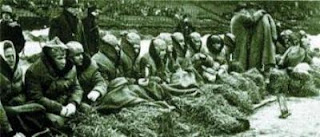
Cleveland Rams players trying to stay warm during the 1945 NFL Championship Game

Tuesday, December 7, 2010

December 7, 1941: The last game

WASHINGTON - On the field, the Redskins and the Eagles were playing out the string, finishing up a meaningless game to close out a disappointing season. What was happening on the field wasn't important. Not as far as the history books are concerned.

The first announcements starting coming in during the first quarter. Military officers left and right were asked to report to their offices. Nobody was saying why.

Some people knew, of course. Nearly everybody in the press box was aware that the bombs had fallen on Pearl Harbor earlier that day, but most people in the crowd didn't know. The players surely didn't. Redskins president George Marshall wouldn't allow an announcement of the bombing over the loudspeakers, meaning the fans and players in Griffith Stadium were among the last in America to know.

It was hard not to know something was up, though. Redskins quarterback Sammy Baugh took notice of all the announcements, one after the other after the other. It was very unusual to hear that many. And yet the players kept playing.

Before long, the Redskins were 20-17 winners, and the 1941 NFL season was over, at least for Washington and Philadelphia. A few fans ran onto the field toward the goalposts, but most filed out of the stadium still oblivious. That wouldn't last. From the newsboys holding up newspapers and barking out the headlines to passersby on the street telling each other, it soon became painfully clear what had happened, why all those announcements were coming over the loudspeakers.

The game lost meaning. The players who minutes before had been playing a game suddenly wondered when, not if, they'd be drafted. Some players jumped the gun and enlisted themselves. One, Nick Basca of Philadelphia, enlisted three days later with his brother and was shipped to Europe. His brother made it back.

Baugh got a deferment, allowed to stay on his ranch and raise cattle. Throughout the war, he flew on weekends to play for the Redskins. His career lasted until 1952, and he went into the Hall of Fame nine years later.

Eventually football, and all sports, resumed normal activities, and rosters eventually went back to their pre-war quality and quantities. It's hard to imagine there will ever again be a game where time stood still, where nobody inside knows just how much the world outside had changed. For two hours on December 7, 1941, in Griffith Stadium in Washington, D.C., there was no bombing of Pearl Harbor. There was no war that the United States was now fully engaged in. There was just football. The last moment of innocence before four years of heartache.

Thursday, November 18, 2010

November 18, 1985: Like a car crash

WASHINGTON - It's easy to find if you want to. A simple search on YouTube, or really any online video site. It'll be there. Go ahead and watch if you want to. A lot of people have, most of them multiple times. Most who watch it never forget it. A lot of them never want to see it again.

The New York Giants weren't fooled by the flea-flicker in that game. Why would they be? Boasting one of the best defenses of the era, one that would almost single-handedly lead them to the championship the next season, the Giants weren't easily fooled by any play. But a flea-flicker against a heavily blitzing team? In retrospect, it seems ludricious.

Of course, hindsight is 20-20. It's easy to see Lawrence Taylor jumping up and down screaming at the Redskins' bench while Joe Theismann lay injured and say "maybe the Redskins shouldn't have run that play." The ill-advised flea-flicker that Taylor blew up in the backfield ended up being the final play of Joe Theismann's career.

At first, the Redskins thought Taylor was taunting them. Why else would he jump up after a sack and scream at the bench? But then the truth began to sink in. Taylor was calling for help. Theismann wasn't getting up. One look, and everybody could see why.

At first, the television cameras didn't show what happened. It looked like Theismann got the pitch back from the running back, got hit by Taylor, and fell awkwardly. Then the Monday Night Football crews showed the reverse angle. Oh, the reverse angle. The one that showed Taylor's body start to swing around as he brought Theismann to the ground, the one that showed the entire weight of Taylor's body falling on Theismann's lower leg, the one that showed the compound fracture. The replay that the producers showed over and over and over again.

It was the repitition that made it the worst. Seeing an injury like that was bad enough, but to keep showing it was just sickening. Sure, ABC had to kill time while the trainers tended to Theismann, but couldn't they have cut to commercial or something? Did they have to keep showing it?

Theismann was an NFL MVP, a Super Bowl champion, and holds most Redskins career passing records. Taylor was an NFL MVP, a two-time Super Bowl champion, and is considered one of the best linebackers of all time. Both, however, are most remembered for the play where Taylor met Theismann in the backfield, and Theismann's lower leg snapped.

Taylor has said that he has never seen the video of that play, and that he never will. It's hard to blame him. Nobody who saw Joe Theismann's career end on Monday Night Football will ever forget it.